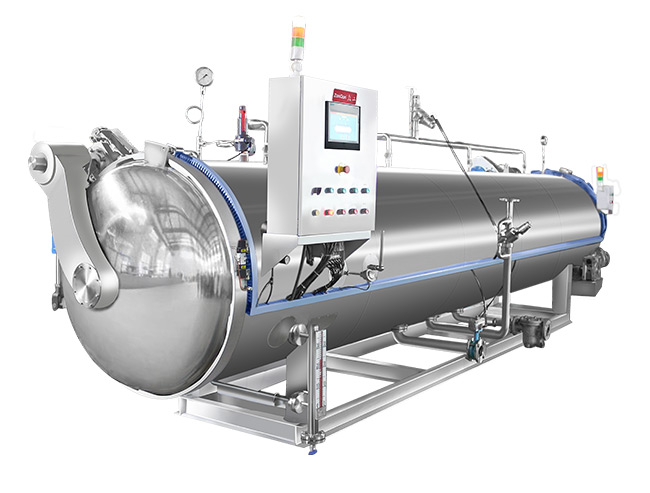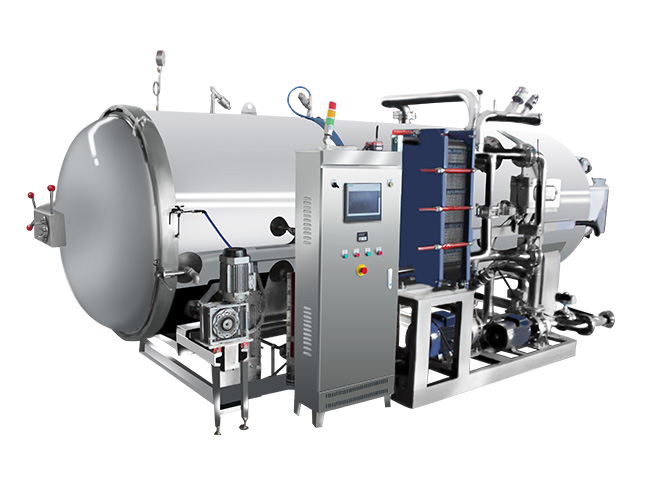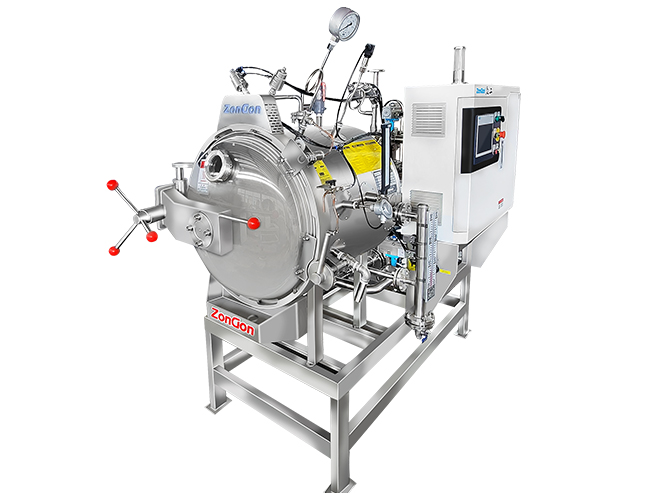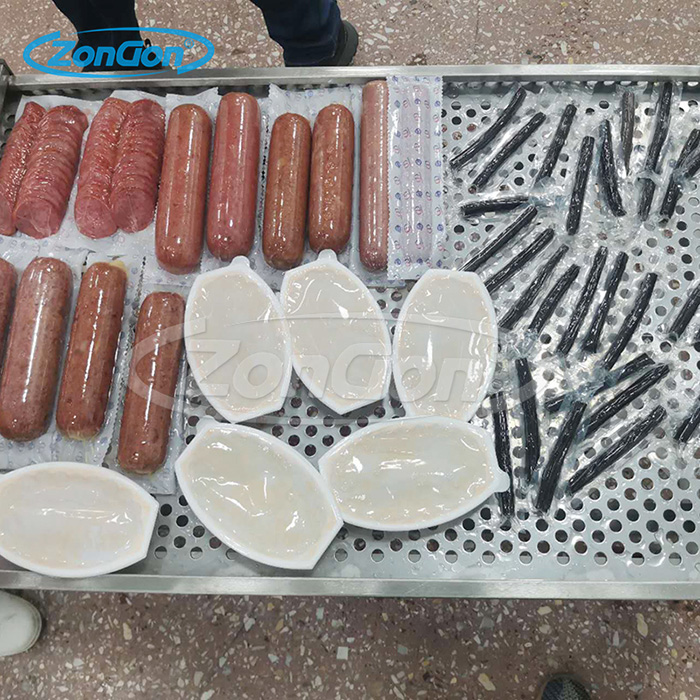
Why are vacuum-sealed packaged foods sterilized using a water immersion retort? Let's analyze this in detail.
The primary reason for using a water immersion retort for vacuum-sealed foods lies in its ability to provide uniform sterilization, effectively prevent package bursting, and better preserve the original quality of the food product.
Here is a systematic analysis across three key aspects:
This is the irreplaceable advantage of water immersion sterilization.
The Root Problem: During high-temperature sterilization, the residual air, moisture, and the food itself inside a vacuum bag (flexible package) expand significantly upon heating, generating substantial internal pressure. Without corresponding external pressure to counterbalance this, the package will inflate like a balloon until it ruptures at its weakest seal.
The Water Immersion Solution: A water immersion retort can apply pressure (called "counter-pressure" or "overpressure") to the water inside the vessel using compressed air during heating. This water pressure is transmitted uniformly and acts on every surface of the flexible package from the outside, effectively "holding down" the bag and counteracting the internal expansion pressure.
Comparison: Pure steam sterilization lacks this uniform mechanical counter-pressure, making package bursting more likely. While steam sterilization with air-over-pressure can provide counter-pressure, heat transfer uniformity is generally inferior to water immersion.
Uniform Heat Transfer: Water, with its high specific heat capacity, distributes temperature far more evenly than steam. This ensures that packages in different locations within the retort, and different parts of the food within the same package, receive nearly identical heat treatment, avoiding "cold spots" (under-processing) or localized overheating.
Gentle Heating: Heat transfer via water is more gradual and gentle compared to steam, resulting in a smoother temperature rise curve. This is crucial for delicate, heat-sensitive products (e.g., fish, fruit pieces, certain sauces) as it minimizes texture degradation (like becoming mushy) and flavor loss caused by instant high heat.
Precise Temperature Control: Water temperature is easier to measure, control with high precision, and maintain stably compared to steam temperature. This reliability is essential for the food industry to strictly execute sterilization formulas (specific time/temperature combinations) to ensure both safety and quality.
Building on the points above, water immersion sterilization leads to a superior end product:
Intact Appearance: Effectively prevents package bursting and excessive deformation, ensuring good product presentation.
Superior Texture & Mouthfeel: Uniform and gentle heating prevents localized "overcooking," better preserving the fibrous texture of meats and the crispness of vegetables.
Flavor & Nutrient Retention: Reduced thermal shock and a shorter effective sterilization time (due to uniform heating) help minimize excessive Maillard reactions, vitamin degradation, and the development of off-flavors.
Clear Brine/Liquid: For products packed in liquid, the stable pressure environment prevents violent boiling of the brine/sauce, avoiding agitation that can cause cloudiness.
In conclusion, the water immersion retort is the preferred sterilization method for packages with low rigidity that require external pressure support, such as vacuum flexible packages, pouches, plastic trays/bottles, and glass jars. It perfectly resolves the core conflict during thermal processing for such packages—the conflict between internal thermal expansion pressure and the package's limited pressure-bearing capacity—while achieving an optimal balance of uniformity, controllability, and product quality preservation.
Although its energy consumption may be slightly higher than pure steam sterilization, for high-value-added, quality-focused vacuum-packaged foods, the high yield and superior product quality offered by water immersion sterilization make it an indispensable key process.
call me+8615169670012
Email: zongon@zongon.com
ADD: Xinxing Town Station, Weifang, Shandong, China
 English
 中文简体
中文简体